
.avif)

In the world of software development, trust and continuity are critical. Whether you're an independent developer or part of a larger team, your clients rely on your software to maintain daily business operations.
However, if an unforeseen disruption event were to happen, what would happen if you're no longer able to support your service? This is where Software Escrow comes into play as a risk mitigation tool. Essentially, it’s a safety net that protects both developers and clients.
What Is Software Escrow?
Are you new to Software Escrow? If so, check out our blog – "A Beginner’s Guide to Software Escrow".
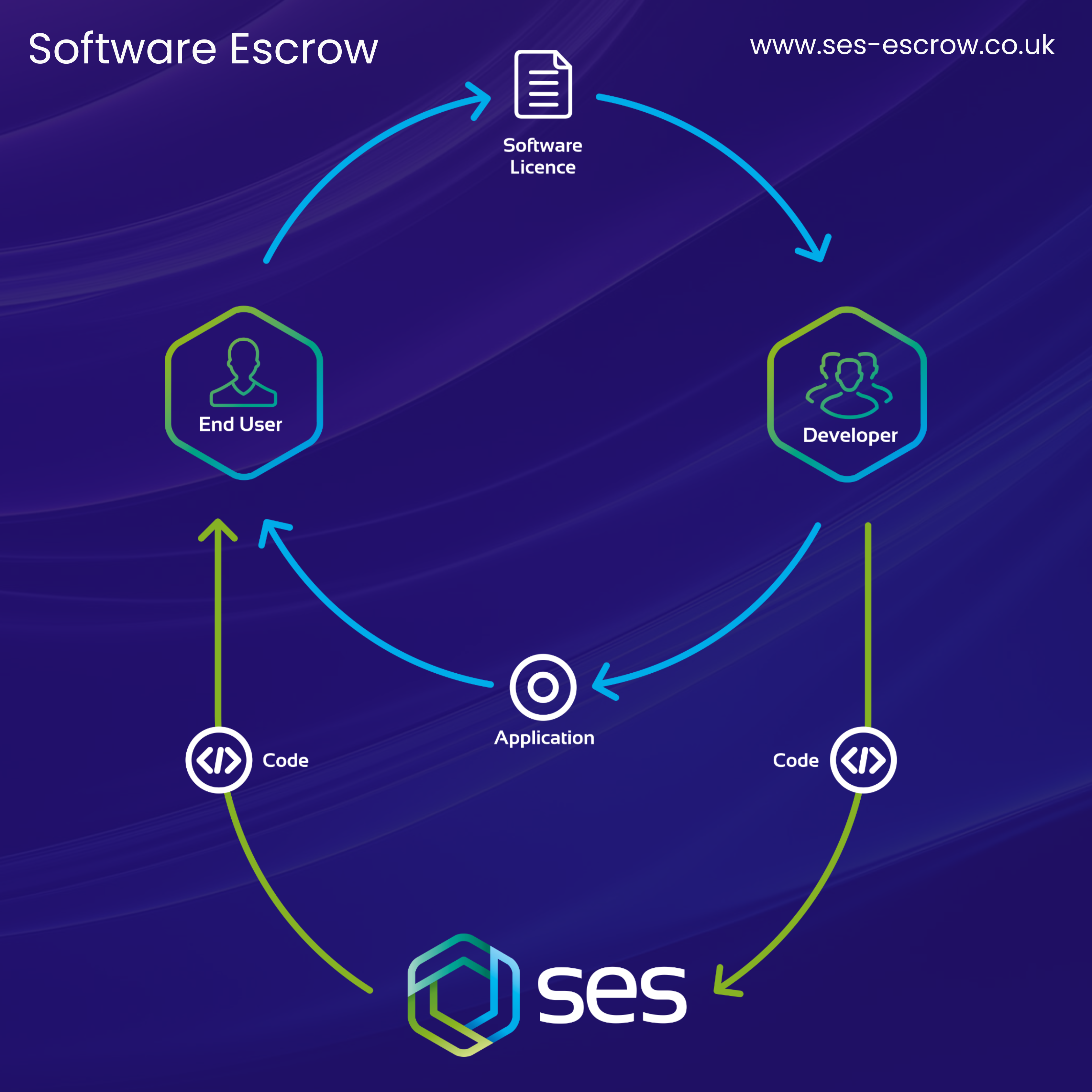
Software Escrow is third-party risk mitigation tool that supports the purpose of ensuring business continuity. A Software Escrow Solution typically involves a tri-party legal agreement between:
- The end user (the end-user of the application)
- The vendor (the software developer/owner)
- A trusted Escrow agent/provider, such as SES Secure.
A Software Escrow agreement provides these parties with the comfort of knowing that a business can maintain operational activities, even when faced with vendor failure.
The Escrow process involves a software developer/owner depositing a critical application’s source code and other relevant materials with an Escrow agent. These materials are then tested and verified ahead of being securely stored. If a situation were to occur in which an end-user’s access to a critical application is negatively impacted, a Software Escrow Solution would enable a software application’s source code to be released to an end-user, re-equipping them with control and operational access.
Due to the level of influence that a critical application can have on business performance and stakeholder relationships, Software Escrow can support businesses with not only risk mitigation but also with the protection of their financial position, as well as their overall reputation.
Why Should Developers Care About Software Escrow?
While Software Escrow is often seen as a client-driven requirement, significant benefits can also be harnessed by software developers, such as:
Instilling Confidence and Trust in Clients
Clients are more likely to invest in your software if they know they won’t be left stranded if a worst-case scenario were to unfold. Software Escrow offers reassurance through enabling them a way to maintain access to a critical application’s source code and documentation if something goes wrong, making your offering more attractive.
Protecting Intellectual Property
Software Escrow agreements are carefully structured to ensure that your IP is only released under agreed-upon conditions, known as release conditions or release triggers. This means you retain control over your code while still offering clients peace of mind. To read about an SES client’s first-hand experience with a release event (a situation in which an Escrow agent releases source code and other materials) during an unexpected disruption event, check out our case study – "SES Secure Client Case Study – Software Escrow Release Event".
Demonstrates Professionalism and Forward-Thinking
The implementation of Software Escrow demonstrates an approach that is proactive and places risk mitigation at the forefront. Whilst disruption events may seem unlikely, all businesses, regardless of their size and stature, are susceptible to risk. Having a Software Escrow Solution in place showcases consideration and effective preparation for all possible future outcomes.
What is Included Within a Software Escrow Solution?
A typical Software Escrow Solution includes:
- Source code and detailed build instructions.
- Documentation for installation, configuration, and maintenance
- Release conditions that define the situations in which an Escrow agent can release the materials.
- Verification services to ensure the code is complete, reliable, and can be successfully redeployed.
At SES Secure, no two solutions are the same. Each solution is completely bespoke and customisable to cater to the unique needs, preferences, and specifications of the client.
To learn more, please see the recording of our webinar- 'A Developer's Guide to Software Escrow' below: