
What is the Cyber Security and Resilience (CSR) Bill?

Published on 19/11/2025

Earlier this month, the UK government introduced a new legislation, the Cyber Security and Resilience (CSR) Bill. The legislation was introduced to strengthen national defences against cyberattacks, modernise outdated regulations, and protect critical services such as healthcare, energy, water, transport, and data infrastructure.

The CSR Bill marks a major turning point in UK cyber legislation, ensuring that critical infrastructure and service providers adopt baseline security standards and respond quickly to incidents. It places clear accountability on both public and private sectors to protect the vital systems that underpin everyday life.
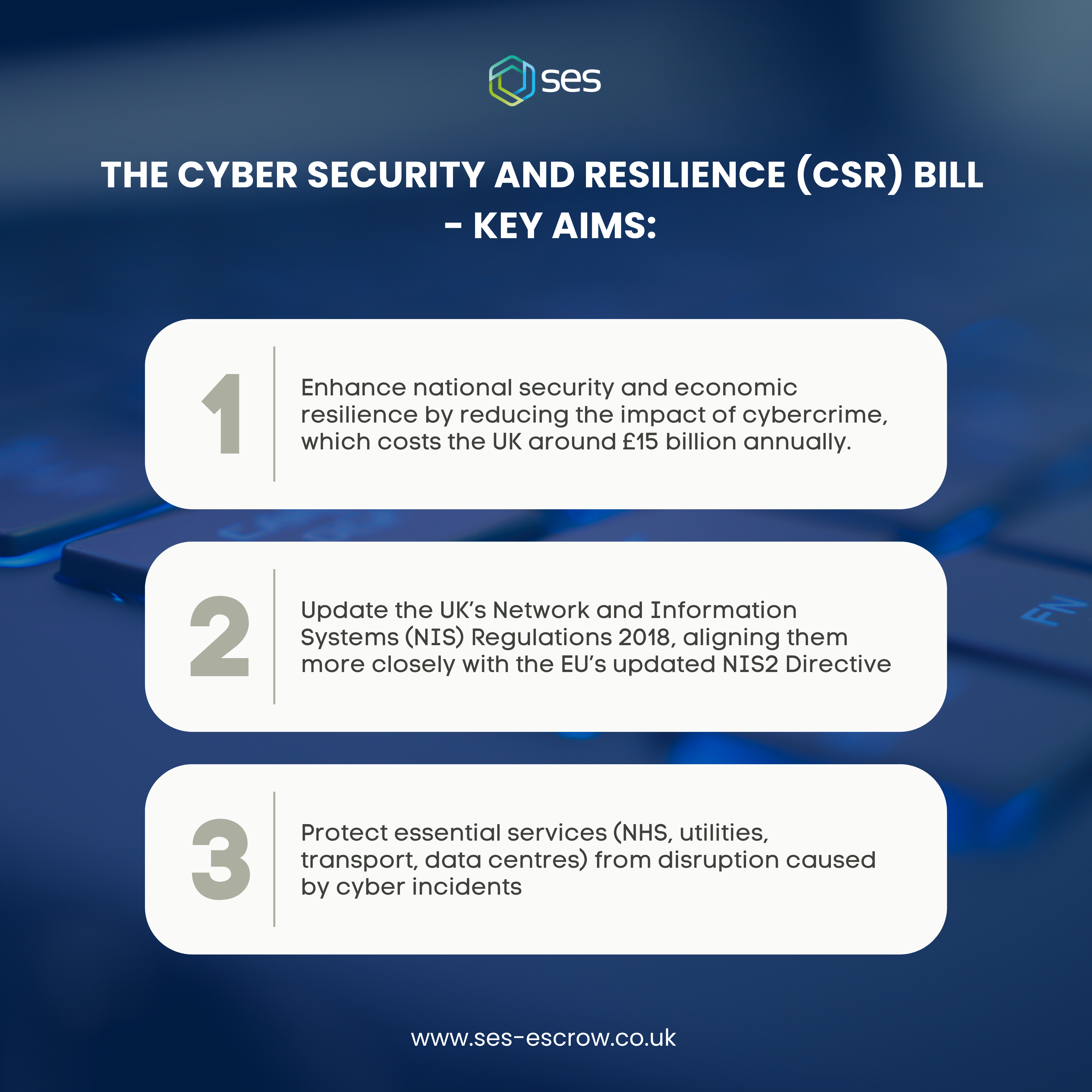
  The Cyber Security and Resilience Bill 2025 key aims

The Purpose of the CSR Bill

The CSR Bill, which was introduced to Parliament on 12 November 2025, builds on the Network and Information Systems (NIS) Regulations 2018. Those earlier rules were determined by the EU’s NIS Directive, but with the EU moving to NIS2, there became a need for the UK to establish its own updated framework. The Cyber Security and Resilience Bill addresses the following factors:

  • Rising cyber threats: these have exposed alarming vulnerabilities within national security.
  • Critical infrastructure focus: Attacks on healthcare, energy, transport, and government services have exposed vulnerabilities.
  • National security priority: The Bill is part of the government’s broader “Plan for Change,” ensuring essential services remain resilient in the face of escalating digital risks.

Moving Forward, What Does the CSR Bill Mean?

The legislation introduces several important measures:

  • Expanded incident reporting: Organisations must report within 24 hours of a cyber incident, followed by a full report within 72 hours.
  • Inclusion of datacentres: Datacentres are recognised as critical national infrastructure and must now meet strict cybersecurity standards.
  • Regulation of managed service providers: Medium and large IT and cybersecurity service providers will face new duties, including recovery planning and compliance checks.
  • Supplier oversight: Regulators can identify and enforce standards on companies supplying essential services, such as medical diagnostics or chemicals for water treatment.
  • Agile regulatory powers: The government gains flexibility to adapt rules quickly as cyber threats evolve.

A Huge Step for the UK’s Defence Strategy

The Cyber Security and Resilience Bill represents a major leap forward in the UK’s cyber defence strategy. Through expanding the scope of regulation, tightening reporting timelines, and addressing weak points in supply chains, it sets a new standard for resilience in an increasingly digital society.

This Bill is not just about safeguarding systems, it’s about protecting lives, livelihoods, and the trust that underpins modern economies.

Contact us

If you would like further information, discuss your requirements, get a free no obligation quotation or just a friendly chat on how we could possibly help please fill in the details below and one of our team will get back to you as soon as possible.
Tick the box to receive regular updates and industry insights